WhatsApp Usernames Face Backlash in Kenya as Users Fear Losing Contacts and Business Connections
WhatsApp’s new username feature was introduced as a privacy upgrade, allowing users to communicate without revealing their phone numbers to people they do not know. However, the feature is now attracting criticism in Kenya, with some users and small-business owners reconsidering whether hiding their numbers is worth the inconvenience.
The growing debate highlights a familiar challenge in technology: a feature designed to improve privacy can also make everyday communication more complicated.
Kenyan media outlets, including Mpasho and Tuko, have reported concerns from users who say they prefer the traditional phone-number system because it makes them easier to reach.
Why Are Kenyans Complaining About WhatsApp Usernames?
For years, a phone number has served as the primary identifier for a WhatsApp account. When people exchanged numbers, they could communicate through WhatsApp while retaining the option to make an ordinary phone call or send an SMS.
WhatsApp usernames change that arrangement.
According to WhatsApp’s official explanation, users who enable a username can hide their phone numbers from people who have not already saved those numbers in their contacts. Instead, the other person sees the username.
The problem arises when someone wants to contact a person outside WhatsApp but does not have their phone number.
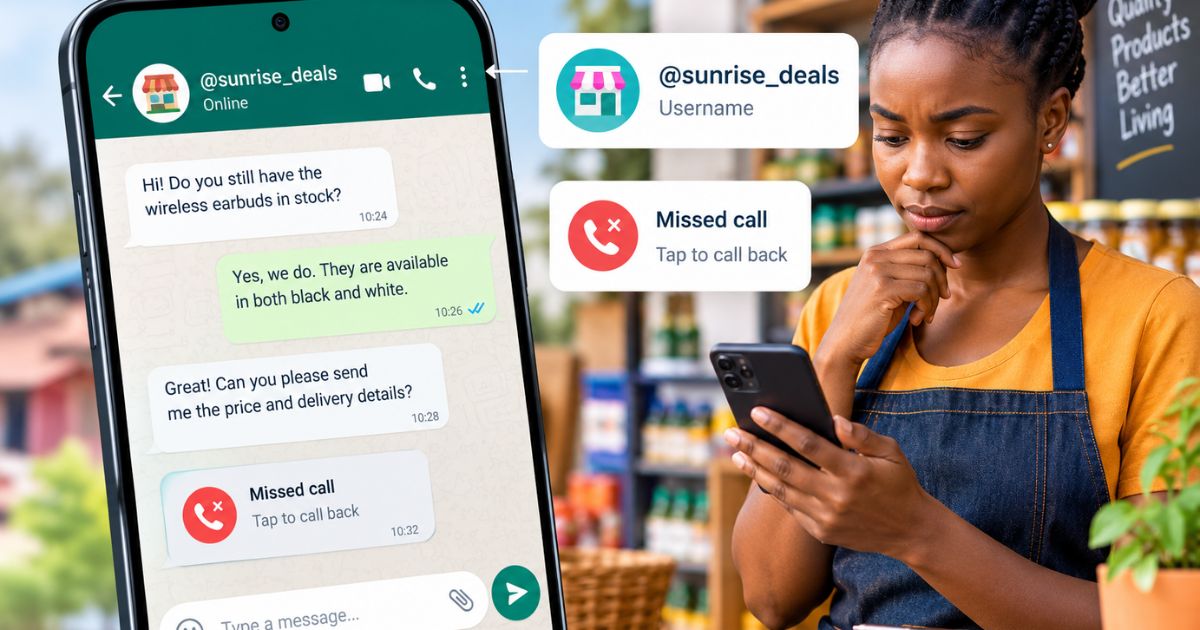
For example, a customer who has communicated with a trader on WhatsApp might want to call to confirm a delivery. If the customer has never saved the trader’s number, they may be unable to make an ordinary call using the information available in the conversation.
The same challenge can affect people who meet at professional events, exchange WhatsApp details and later need to reconnect by telephone.
Are People Actually Losing Their WhatsApp Contacts?
One important distinction needs to be made: hiding a phone number does not automatically mean WhatsApp has deleted the contact or conversation.
WhatsApp’s documentation explains that existing conversations can continue normally after a username is created. People who already have the user’s number saved will continue to see the saved contact information and phone number.
However, the experience is different for people who have not saved the number. WhatsApp says creating a username removes the phone number from existing conversations with people who do not have it saved.
This can make it harder to identify someone, retrieve their number or contact them outside the app.
Consequently, what some users describe as losing contacts may actually be a loss of access to identifying information rather than the deletion of their chats.
The distinction matters because users need to understand precisely what the feature changes before deciding whether to enable it.
Small Businesses Could Feel the Biggest Impact
For Kenyan entrepreneurs, WhatsApp is more than a messaging platform. It is also a sales channel, customer service desk and a convenient way to maintain relationships with customers.
Small traders regularly use WhatsApp to share product photographs, negotiate prices, coordinate deliveries and respond to enquiries.
When customers can see a business’s telephone number, they have another way to reach the seller if WhatsApp messages go unanswered.
With a username, a customer who has not saved the number may need to continue communicating through WhatsApp or obtain the telephone number separately.
This becomes particularly inconvenient when a business owner is offline, has run out of data bundles or is unable to respond immediately.
A customer trying to confirm a delivery or obtain directions may prefer to call rather than wait for a message response.
These concerns help explain why some Kenyan traders are reconsidering the feature. Reports published by K24 Digital and Techweez have also highlighted the tension between privacy and accessibility.
Nevertheless, there is not yet sufficient evidence to conclude that WhatsApp usernames are causing widespread business losses across Kenya. The reports demonstrate genuine concerns among some users, rather than a measured nationwide economic impact.
Privacy Versus Accessibility: What Is the Real Trade-Off?
WhatsApp’s decision to introduce usernames addresses a legitimate privacy concern.
Sharing a telephone number with strangers in large groups, community forums or business conversations can expose users to unwanted calls, messages and potential harassment.
A username provides an alternative for people who want to communicate without immediately disclosing their telephone numbers.
However, a phone number also provides a practical means of communication outside the application. Hiding it can reduce that accessibility for people who have not saved it.
The two sides of the debate can be summarised as follows:
Advantages of usernames
- Reduce exposure of phone numbers to new contacts.
- Allow people to communicate without immediately exchanging personal numbers.
- Provide an alternative identifier for public-facing accounts.
- Give users more control over who can contact them for the first time.
Potential disadvantages
- Make it harder to retrieve a person’s number from a conversation.
- Complicate direct calls and SMS communication with new contacts.
- Add friction to professional networking and customer relationships.
- Require users to learn a different way of finding and identifying people.
Ultimately, the question is not whether privacy is important. It is whether users should have to sacrifice convenient access to telephone contact information to achieve it.
Can Users Remove Their WhatsApp Usernames?
Yes. WhatsApp usernames are optional, and users can change or delete them.
According to the WhatsApp Help Centre, users can manage their usernames through the application. Deleting a username allows people to see the user’s phone number again, subject to WhatsApp’s contact and privacy behaviour.
Users who prefer to retain their usernames should consider sharing their telephone numbers separately with important contacts, especially customers, colleagues, suppliers and family members who may need to reach them outside WhatsApp.
Businesses can also display their telephone numbers on websites, social media pages, invoices and other customer communication channels.
These steps preserve the privacy benefits of usernames while maintaining alternative ways to communicate.
What WhatsApp Could Do to Address the Concerns
WhatsApp does not necessarily need to abandon usernames to resolve the concerns being raised.
Instead, the company could explore clearer options that allow users to balance privacy with accessibility.
For instance, users could have more visible control over when their telephone numbers are shared, alongside clearer explanations of how usernames affect existing conversations.
The platform could also make it easier to share a telephone number voluntarily when exchanging contacts for business or professional purposes.
More importantly, WhatsApp should ensure that users understand the implications of enabling a username before they activate the feature.
A privacy setting is most useful when users understand what information becomes hidden, who can still access it and how they can communicate with people outside the platform.
Final Thoughts: Should You Keep Your WhatsApp Username?
WhatsApp usernames offer a useful privacy improvement, particularly for people who regularly communicate with strangers. However, they may not be the best option for everyone.
For users who prioritise privacy, usernames can provide an additional layer of control. For traders, service providers and professionals who depend on being reachable by telephone, keeping a visible contact number or sharing it through another channel may be more practical.
The most important point is that a username should not become a barrier to maintaining valuable connections.
WhatsApp’s challenge will be to make private communication easier without undermining the simple, reliable contact-sharing system that helped make the platform popular in the first place.
As the feature rolls out, Kenyan users will have to decide whether the privacy benefits outweigh the inconvenience. For WhatsApp, the response to this debate could help determine how successfully the platform balances personal privacy with the realities of everyday communication.
What do you think? Have WhatsApp usernames made communication safer, or are they making it harder to connect with people and businesses? Share your views with us.