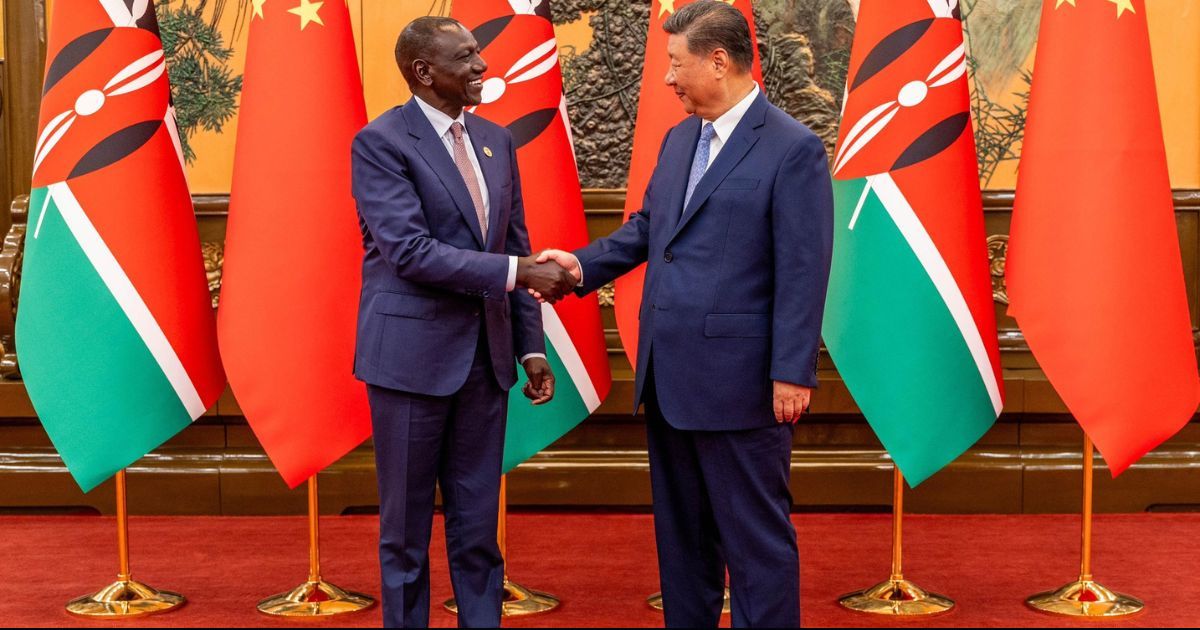
Kenya Switches to Yuan to Settle Chinese Loan Interest
Kenya has completed a landmark currency conversion on its largest single piece of foreign debt, swapping dollar-denominated loans from China into yuan in a move that is expected to save the country roughly $215 million a year — and that is already drawing the attention of other debt-stressed governments across Africa and Asia.
The Deal
On October 7, 2025, Kenya’s Treasury Cabinet Secretary John Mbadi announced the completion of a conversion covering three loans worth a combined $5 billion (Ksh646.15 billion), originally borrowed from the Export-Import Bank of China (China Exim Bank) between 2014 and 2015. The money financed Kenya’s Standard Gauge Railway (SGR), a roughly 600-kilometer line linking the port city of Mombasa to Naivasha, just outside Nairobi — the country’s biggest infrastructure undertaking since independence.
By June 2024, about $3.5 billion of that debt remained outstanding, and Kenya had been spending close to $1 billion annually just servicing its obligations to China, which is its single largest bilateral creditor. Loan repayments to China Exim Bank alone accounted for roughly a quarter of Kenya’s external debt-servicing costs in the fiscal year ending June 2025.
Why the Switch Saves Money
The economics come down to interest rate spreads. The SGR loans were originally priced off a US dollar benchmark, and two of the tranches carried margins of 3 and 3.6 percentage points above that rate. When their grace periods expired in 2019–2020, total interest costs sat around 4%. As global rates rose, that cost more than doubled by 2023 — turning a once-manageable loan into a serious fiscal drag.
Converting the debt into yuan moves it onto China’s lower benchmark rate, cutting the effective interest cost roughly in half — from north of 6% to around 3%, according to Treasury officials. Combined with extended maturities — two of the loans were stretched to 15-year terms with a four-year grace period — the restructuring is projected to save Kenya about $215 million a year, with one government accounting update putting realized first-year savings closer to $167 million.
A Bigger Pattern
Kenya’s move is notable for being the first time China has agreed to this kind of currency conversion with an African sovereign borrower, and it appears to be setting a template. Within weeks, Ethiopia opened talks with Beijing to convert part of its own $5.38 billion in Chinese debt into yuan. A study by the research group AidData has since found that at least five other African and Asian nations are now exploring similar swaps, viewing the Kenyan precedent as a possible blueprint for easing dollar-linked debt burdens.
The timing fits into a broader push by Beijing to internationalize the yuan and expand its use in cross-border lending and trade — part of a longer-term strategy to reduce the dollar’s dominance in global finance. Indonesia, for instance, recently raised the equivalent of about $842 million by issuing yuan-denominated bonds to international investors for the first time. Analysts have described Kenya’s deal as a “win-win”: it eases Nairobi’s fiscal pressure while advancing China’s currency ambitions.
Not Without Risk
The International Monetary Fund has urged caution. Having converted dollar debt into yuan, Kenya (and Ethiopia, which is moving in the same direction) now carries currency risk tied to the renminbi rather than the dollar — meaning the value of those savings could erode if the yuan strengthens or if Kenya doesn’t generate enough yuan-denominated revenue or reserves to comfortably service the debt. Kenya’s central bank governor has pushed back on suggestions that the country is meaningfully shifting its reserve composition toward the yuan, noting renminbi holdings remain a modest share of total reserves.
There’s also a diplomatic subtext. According to David Ndii, an economic adviser to President William Ruto, Western multilateral lenders had raised concerns that Kenya was using concessional financing from institutions like the IMF and World Bank to free up money that ultimately serviced Chinese obligations — pressure that reportedly influenced Nairobi’s push to restructure the China debt directly.
The Bigger Picture for Kenya
The yuan swap is one piece of a wider debt-management strategy as Kenya’s public debt approaches 70% of GDP and the IMF rates the country at high risk of debt distress. Alongside the China restructuring, Kenya has issued $1.5 billion in Eurobonds twice this year and secured a commercial loan facility backed by the UAE — diversifying its creditor base rather than leaning more heavily on any single source. Kenya has even floated the idea of issuing a “panda bond” — yuan-denominated debt sold in China’s domestic market — to help fund a planned extension of the SGR toward the Ugandan border.
For now, the deal offers Nairobi real breathing room on one of its costliest debts. Whether it becomes a template other nations can safely follow — or a cautionary tale about swapping one currency risk for another — will depend largely on how the yuan, and China’s broader lending terms, evolve in the years ahead.