Ruto at the G7: Key Takeaways from Kenya’s Évian Diplomacy
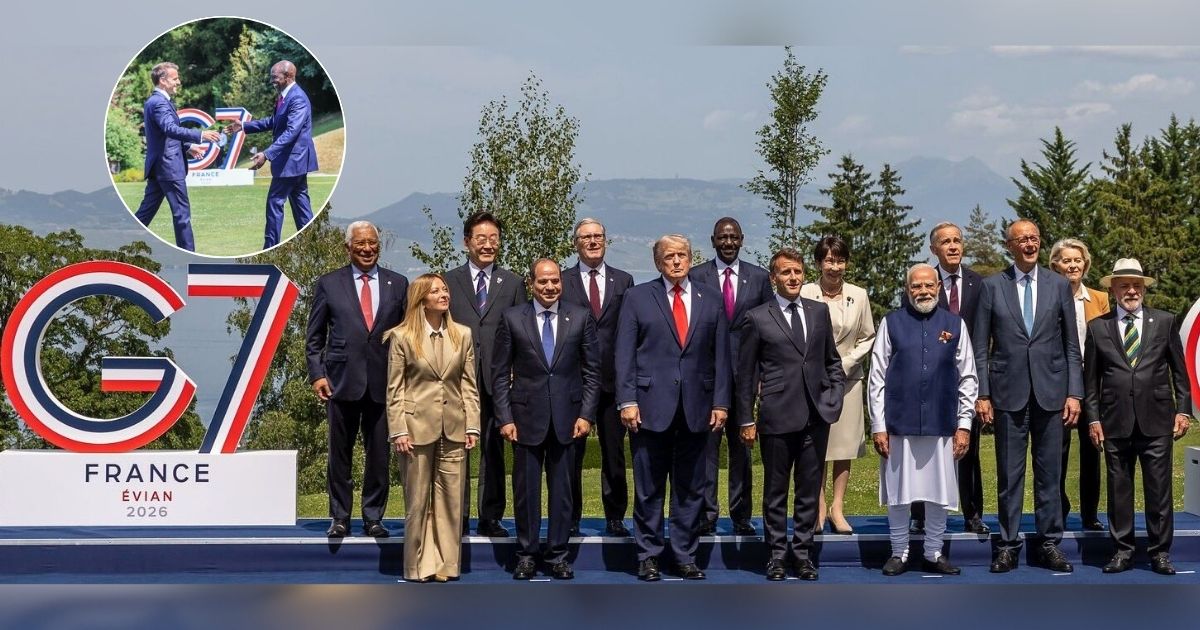
H. E. President William Ruto represented Kenya, and by extension Africa, at the 52nd G7 Leaders’ Summit, held in Évian-les-Bains, France, from June 15 to 17, 2026. The invitation came directly from French President Emmanuel Macron, and it placed Kenya among just five guest nations at the table — alongside India, Brazil, South Korea and Egypt. Notably, Kenya was the only African country invited this year, after South Africa was reportedly dropped from the guest list amid pressure from the United States.
Here are the key takeaways from the trip.
- Kenya was positioned as Africa’s voice, not just a guest
Kenya framed its presence at Évian as that of an “agenda-shaping partner” rather than an observer. Ruto carried forward priorities set at the Africa Forward Summit held in Nairobi the month before, and used his keynote intervention — delivered during the G7+ working session on “Fostering New Partnerships and Rebuilding International Solidarity” — to argue that Africa should no longer be viewed through what he called a deficit lens. His most quoted line framed the continent as a source of opportunity rather than a problem to be managed.
- The central ask was cheaper capital, not more aid
Ruto’s core message throughout the summit was about reforming the cost of borrowing for African countries, not increasing handouts. He argued that African economies are charged higher interest rates than peers with comparable fundamentals, a pattern he has repeatedly called “capital injustice.” His proposed fix leans on guarantees and risk-sharing instruments — channeled through institutions like the African Trade and Investment Development Insurance (ATIDI) and the Multilateral Investment Guarantee Agency (MIGA) — to convert perceived risk into investor confidence. He also pointed to Africa’s roughly $4 trillion in pension funds, insurance pools and reserves as underused domestic capital that better financial architecture could mobilize.
- G7 leaders endorsed a debt-reform declaration
Hours after Ruto’s remarks, G7 leaders adopted a “declaration on mutually beneficial international partnerships,” which Kenya and South Korea also endorsed as invited guests. The declaration named debt reform as a priority, with commitments to greater transparency in debt data and lending practices, and continued work on debt restructuring frameworks under the G20 Common Framework. Kenyan officials said the summit’s outcomes were captured across eight separate documents touching on finance, infrastructure, health, AI and critical minerals.
- A packed bilateral schedule on the sidelines
Beyond the main sessions, Ruto held one-on-one meetings with a string of leaders:
Narendra Modi (India) — reaffirmed cooperation on trade, technology and Global South coordination
Friedrich Merz (Germany) — deepened ties in renewable energy, trade, agriculture and MSME development
Volodymyr Zelensky (Ukraine) — agreed to fast-track a grain hub at the Port of Mombasa to bolster regional food security
Lee Jae-myung (South Korea) — reached a seafarers’ certification deal and discussed market access for Kenyan tea and coffee
Ajay Banga (World Bank) — discussed financing for Kenya’s development priorities
Donald Trump (United States) — a brief, informal interaction on the sidelines of a social event
- Tech executives got as much attention as heads of state
Évian’s sidelines doubled as an informal tech summit for Ruto, who met executives from OpenAI, Anthropic, Google, Microsoft, Meta, Nvidia, Mistral AI, Cohere and several other AI firms. On AI governance specifically, he pushed for child-safety protections — age-appropriate design, better content moderation, and safeguards built for African-language contexts such as Kiswahili and Sheng — reflecting Africa’s young and fast-growing digital population.
- The reception back home was mixed
Kenyan commentary largely treated the diplomatic access itself as a win, but with a consistent caveat: visibility abroad means little without delivery at home. Some analysts and members of the public questioned the frequency and cost of Ruto’s foreign trips relative to domestic economic pressures, and at least one academic warned of perception risks — that closer alignment with Western powers could be read domestically as compromising Africa’s independent voice. The dominant framing in Kenyan media was that Évian was “an opening, not a destination,” with the real test being whether reduced borrowing costs and new investment actually materialize.
THE BOTTOM LINE
Ruto used the G7 platform to repackage Africa’s pitch to the world’s richest economies — away from aid dependency and toward investment, guarantees, and structural reform of who gets to borrow cheaply and why. Kenya secured visible diplomatic wins: a debt-reform declaration, a clutch of bilateral deals, and a seat in rooms it’s historically been excluded from. Whether it converts into lower borrowing costs and real investment for ordinary Kenyans is the open question that will likely shape how this trip is judged in hindsight.